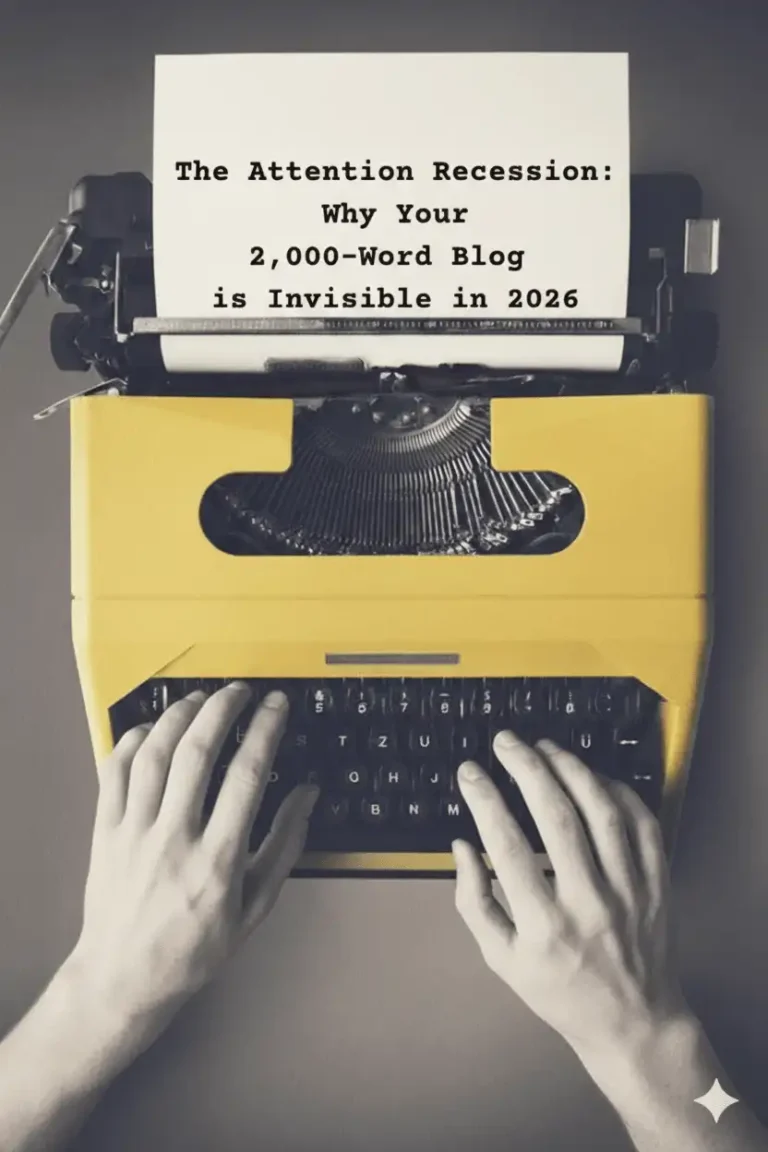
The Attention Recession: Why Your 2,000-Word Blog is Invisible ?
You’ve spent days researching, hours typing, and even more time obsessing over the perfect header image. Your word count clock finally hits 2,000. It feels like a masterpiece, a definitive guide that surely deserves the top spot on Google. You hit publish, lean back, and wait for the flood of readers. But nothing happens. The views stay in the single digits and the only person who shared it was your mom !.
It’s a frustrating reality for many writers and business owners. We’ve been told for years that long-form content is king. We were led to believe that if we just wrote more than the other guy, we would win. But the truth is that a 2,000-word blog post can be just as invisible as a single tweet if it isn’t built with a soul.
The first reason your long post is gathering digital dust is that you might be writing for a robot instead of a person. Many of us get so caught up in keywords and search engine optimization that we forget there is a human being on the other side of the screen. When you stuff a post with repetitive phrases just to please an algorithm, the writing becomes stiff and robotic. People can sense that. They don’t want to read a manual written by a machine they want to hear from someone who understands their problems. If your writing feels like a chore to get through, readers will bounce off the page faster than they arrived.
Then there is the issue of the ‘fluff factor’. Sometimes, we hit 2,000 words not because we have that much value to give, but because we think we have to meet a quota. We repeat ourselves, use ten words where two would do, and go on long tangents that don’t actually help the reader. In a world where everyone is busy and attention spans are shorter than ever, respect for the reader’s time is the greatest gift you can give. If your 2,000 word post could have been a 500 word post, you haven’t written a ‘deep dive’, you’ve written a barrier.
Visibility also relies heavily on how you present that information. Imagine walking into a room filled from floor to ceiling with boxes. You wouldn’t know where to start and you’d likely feel overwhelmed and leave. That is what a ‘wall of text’ feels like to a reader. Even if your advice is life-changing & if it looks like a giant, unbroken block of grey text, nobody is going to read it. Humans scan before they commit. We look for white space, short sentences, and a rhythm that feels easy on the eyes. If your blog looks like a legal contract, people will treat it like one and ignore it.
We also have to talk about the ‘So What?’ factor. You might be the world’s leading expert on a topic, but if you don’t tell the reader why this matters to them in the first three sentences, they are gone. High word counts often lead to long, academic introductions that delay the payoff. Your audience is looking for a solution, a laugh, or a new perspective. If you make them dig through 1,500 words of history before you get to the ‘how-to’ part, you’ve lost the battle for their attention.
Finally, a blog post is often invisible because it lacks a heartbeat. It’s safe. It’s neutral. It sounds like every other article on the internet. To be visible, you have to be willing to have an opinion. You have to share a personal story, admit a mistake, or take a stand on something. People don’t bookmark facts. They bookmark feelings and connections. They return to writers who make them feel seen or challenged.
Length is not a substitute for depth. A 2,000 word post isn’t invisible because it’s long, it’s invisible because it’s missing the spark that turns a document into a conversation. Instead of focusing on the word count, focus on the impact. Write until you’ve said what needs to be said, and then stop. When you write with the intent to help one specific person rather than to fill a page, you’ll find that your ‘invisible’ words suddenly start to get noticed.